In industries such as petrochemicals, power generation, and aerospace, reliable sealing technology is crucial for ensuring the safe and stable operation of pipeline systems and equipment. As a high-performance sealing element, spiral wound gaskets play an irreplaceable role in many industrial fields due to their excellent adaptability, resistance to high temperatures and pressures, and superior resilience.
Spiral wound gaskets are composite sealing gaskets made by winding metal strips and non-metallic filler materials together. They combine the strength of metal with the sealing properties of filler materials, forming a flexible spiral structure through a special winding process, effectively achieving a reliable static seal.
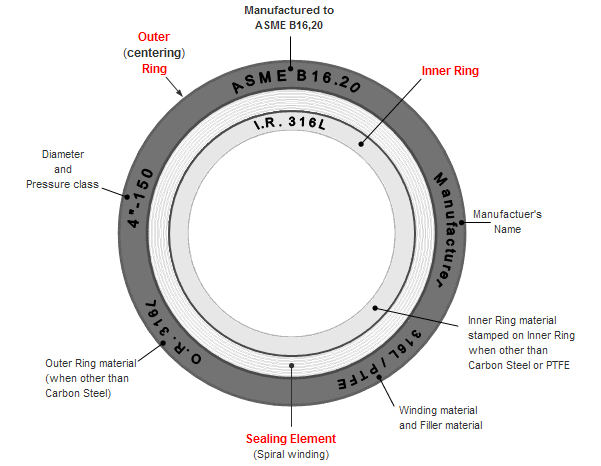
1. Construction and Materials of Spiral Wound Gaskets
The core structure of a metal spiral wound gasket typically comprises four parts:
Metal skeleton: Usually made of high-quality stainless steel (such as 304 or 316 spiral wound gaskets), special alloys (such as titanium alloy spiral wound gaskets or Hastelloy spiral wound gaskets), or carbon steel strip, precision-machined to provide structural support and mechanical strength.
Fill material: As a sealing layer, embedded between the metal strips, commonly made of graphite, polytetrafluoroethylene (PTFE), ceramic fiber, etc., responsible for achieving the main sealing function.
Inner ring: Located on the inner side of the gasket, it prevents the filler material from being washed away by the medium and guides the flow of the medium, enhancing stability.
Outer ring: Located on the outer side of the gasket, it provides positioning and reinforcement, preventing the gasket from being over-compressed and falling apart.
2. Types and Selection of Filler Materials The choice of filler material directly affects the gasket's temperature resistance, corrosion resistance, and sealing performance:
Flexible graphite: The most widely used material, with a wide temperature range (-200℃ to over +500℃, reaching 1600℃ in non-oxidizing environments), good chemical stability, and excellent sealing performance.
Polytetrafluoroethylene (PTFE): Resistant to highly corrosive media, applicable temperature range -200℃ to +260℃, but with poor creep resistance.
Ceramic fiber/mica: Suitable for extremely high temperatures (up to over 1000℃) and high-pressure environments, but with relatively low flexibility.
Selecting the appropriate filler material based on the specific medium, temperature, and pressure conditions is crucial to ensuring a successful seal.
II. Application Advantages: Why Choose Spiral Wound Gaskets? Excellent Sealing Performance: Multi-layer sealing design effectively prevents gas or liquid leakage.
High Temperature and Pressure Resistance: Adaptable to extreme conditions ranging from cryogenic to high temperatures (above 1000℃) and from vacuum to high pressure (typically above 25MPa).
Good Compression Resilience: Compensates for flange displacement caused by temperature and pressure fluctuations, maintaining a long-term seal.
Corrosion and Creep Resistance: Withstands various corrosive media through material combinations and exhibits good relaxation resistance.
Balance of Economy and Reliability: Lower cost compared to pure metal gaskets, and higher reliability compared to non-metallic gaskets, offering outstanding cost-effectiveness.
III. Application Scope Spiral wound gaskets are widely used in:
Petrochemical Industry: Refining units, reactors, heat exchangers, pipe flanges, etc.
Power Industry: Steam turbines, boilers, nuclear power systems.
Aerospace: Engines and fuel systems.
Shipbuilding: Power systems and piping.
Pharmaceuticals and Food: High-standard sanitary systems (requires special material certification).
Working Principle: The Secret of Elastic Sealing
Its sealing principle is based on the "elastic compression-rebound" mechanism. During installation, the bolt pre-tightening force compresses the gasket, causing the filler material to flow and fill micro-defects on the flange surface, forming an initial seal. When the system is supplied with media or the temperature and pressure increase, the internal pressure causes the flange to tend to separate. At this time, the metal skeleton of the gasket provides support, while the filler material and residual elastic force continue to maintain close contact, thus achieving effective sealing under dynamic operating conditions.
IV. How to Select a Suitable Metal Spiral Wound Gasket? Selecting a suitable gasket requires comprehensive consideration of the following factors:
Operating Conditions: Determine the chemical properties, temperature range, and pressure rating of the medium (especially for cyclic operating conditions).
Flange Standards and Dimensions: Confirm the flange type (e.g., RF, FF, RJ, etc.), nominal diameter, pressure rating, and surface roughness.
Material Compatibility: Ensure that the metal strip, filler material, and medium do not corrode or chemically degrade.
Standards and Certification Requirements: Select the appropriate product grade according to industry standards (such as API, ASME, TA-Luft, etc.).
Economic Assessment: Optimize costs while meeting lifespan and safety requirements.
V. Key Installation Steps to Ensure Sealing Effectiveness Preparation: Clean the flange sealing surface, ensuring it is free of scratches, rust, or old gasket residue.
Inspection: Verify the gasket model and material, confirming it is undamaged.
Positioning: Accurately align the gasket with the flange hole, avoiding forced insertion.
Pre-tightening: Tighten the bolts gradually in a diagonal sequence to achieve 30%-50% of the specified pre-tightening force.
Final Tightening: Tighten again in multiple steps (at least 3 steps) in a diagonal sequence to the design torque value, ensuring even stress distribution.
Hot Tightening if Necessary: For high-temperature operating conditions, it may be necessary to stop the system for re-inspection or hot-tightening after the system has heated up.
VI. Relevant Domestic and International Standards for Spiral Spiral Gaskets International/American Standards: ASME B16.20, API 601, MSS SP-44
European Standards: EN 1092, DIN 2697
German Certification: TA-Luft (for low-emission sealing)
Commonly Used in Petrochemical Industry: HG/T 20610 (PN series), HG/T 20631 (Class series) Nuclear Power Plant Application: RCC-M (France)
Selecting gaskets that conform to applicable standards is fundamental to ensuring system compliance and safety.
With their scientific structural design, flexible material combinations, and excellent sealing performance, spiral spiral gaskets have become indispensable sealing elements in modern industry. Correct selection, installation, and maintenance of spiral spiral gaskets can not only effectively prevent leaks and ensure safety, but also reduce maintenance costs and improve system operating efficiency.
