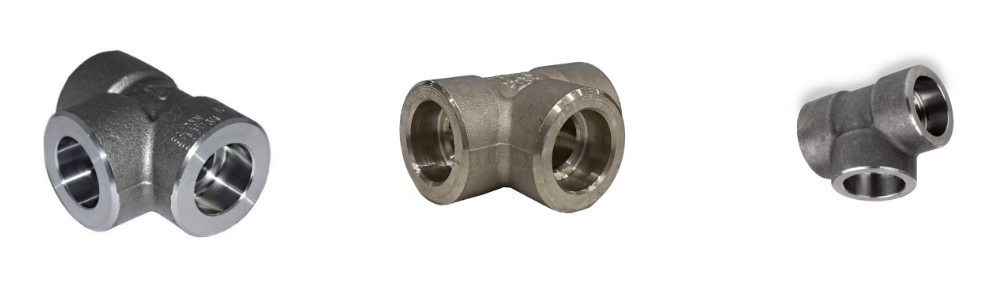
Forged Steel Tee Supplier,Forged Steel Tee Manufacturer,Forged Steel Tee Stockist Forged steel tees refer to a production process for pipe joints. This process is usually used to produce pipe joints for connecting different pipes or equipment to achieve fluid transmission or transfer. In the manufacturing process of forged tees, the raw materials are heated to a certain temperature, and then force is applied on a large forging press. Through processing steps such as pressing and cutting, the shape and internal structure of the tee are finally formed.
Forged tees have many advantages, making them one of the important components in fluid delivery systems. First, due to the deformation and shrinkage during the forging process, the internal structure of the forged tee is tighter, and the strength and hardness of the material are higher, thereby improving the reliability and durability of the joint. In addition, the internal flow channel of the forged tee is smoother, which reduces the resistance of the fluid and improves the efficiency of fluid transmission. In addition, due to the control of the forging process, the manufactured tee has high dimensional accuracy, which can achieve better matching and connection effects and reduce the risk of leakage and oil leakage.
The material of the forged tee is usually high-strength alloy steel, stainless steel or carbon steel. According to the occasion and requirements of use, tees of different materials can be selected to meet different working environments and fluid properties. In addition, forged tees usually require heat treatment to improve the toughness and ductility of the material, thereby increasing the reliability and service life of the joint.
Product Description
| Material |
Carbon Steel、Stainless Steel |
| Contact type |
Socket Welding |
| Dimension Specification |
ASME B16.11-2016(Revision of ASME B16.11-2011) |
| Pressure |
3000lb, 6000lb, 9000lb |
| Temperature |
-20°C to +600°C |
| Place of origin |
China |
| Package |
Wooden case with cartons |
| Application |
Petroleum, gas, chemical,metallurgy, construction |
| Advantage |
High quality, good price, faster delivery time, available in all sizes,customized |
| Delivery |
By sea, By air and By express |
| Lead time |
According to the quantities and specifications of each order;
Normal delivery times is from 25 to 35 days after receiving the deposit. |
Forged Steel Tee Parameter
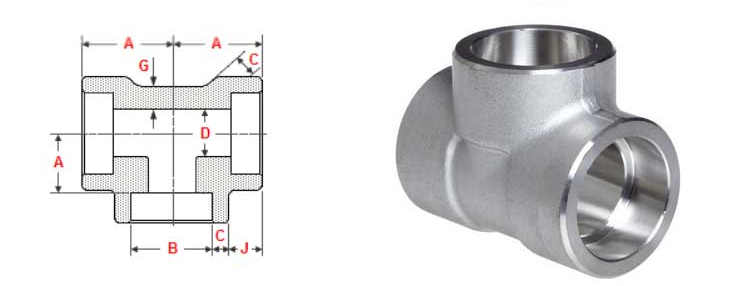
Class 3000 Socket Weld Forged Tee Dimensions NPS 1/2 to 2
| NPS |
Socket Bore |
Depth Socket |
Bore dia |
| B |
J |
D |
| 1/2 |
21.95
21.70 |
10 |
16.6
15 |
| 3/4 |
27.30
27.05 |
13 |
21.7
20.2 |
| 1 |
34.05
33.80 |
13 |
27.4
25.9 |
| 1.1/4 |
42.80
42.55 |
13 |
35.8
34.3 |
| 1.1/2 |
48.90
48.65 |
13 |
41.7
40.1 |
| 2 |
61.35
61.10 |
16 |
53.5
51.7 |
| 2.1/2 |
74.20
73.80 |
16 |
64.2
61.2 |
| 3 |
90.15
89.80 |
16 |
79.5
46.4 |
| 4 |
115.80
115.45 |
19 |
103.8
100.7 |
| 1/2 |
4.65
4.10 |
3.75 |
15.5 |
| 3/4 |
4.90
4.25 |
3.90 |
19.5 |
| 1 |
5.70
5.00 |
4.55 |
22 |
| 1.1/4 |
6.05
5.30 |
4.85 |
27 |
| 1.1/2 |
6.35
5.55 |
5.10 |
32 |
| 2 |
6.95
6.05 |
5.55 |
38 |
| 2.1/2 |
8.75
7.65 |
7.00 |
41.5 |
| 3 |
9.50
8.30 |
7.60 |
57.5 |
| 4 |
10.70
9.35 |
8.55 |
66.5 |
Class 6000 Socket Weld Forged Tee Dimensions NPS 1/2 to 2
| NPS |
Socket Bore |
Depth Socket |
Bore dia |
| B |
J |
D |
| 1/2 |
21.95
21.70 |
10 |
12.5
11 |
| 3/4 |
27.30
27.05 |
13 |
16.3
14.8 |
| 1 |
34.05
33.80 |
13 |
21.5
19.9 |
| 1.1/4 |
42.80
42.55 |
13 |
30.2
28.7 |
| 1.1/2 |
48.90
48.65 |
13 |
34.7
33.2 |
| 2 |
61.35
61.10 |
16 |
43.6
42.1 |
| 1/2 |
5.95
5.20 |
4.80 |
19.5 |
| 3/4 |
6.95
6.05 |
5.55 |
22.5 |
| 1 |
7.90
6.95 |
6.35 |
27 |
| 1.1/4 |
7.90
6.95 |
6.35 |
32 |
| 1.1/2 |
8.90
7.80 |
7.15 |
38 |
| 2 |
10.90
9.50 |
8.75 |
41 |
General notes:
- Dimensions are in millimeters.
- Socket Bore (B) – Maximum and minimum dimensions.
- Bore Diameter (D) – Maximum and minimum dimensions.
- Socket wall thickness – (C) – Average of Socket wall thickness.
- Dimensional tolerances center to bottom of socket – (A)
NPS 1/2 and NPS 3/4 = +/- 1.5 mm
NPS 1 to NPS 2 = +/- 2 mm
NPS 2.1/2 to NPS 4 = +/- 2.5 mm


